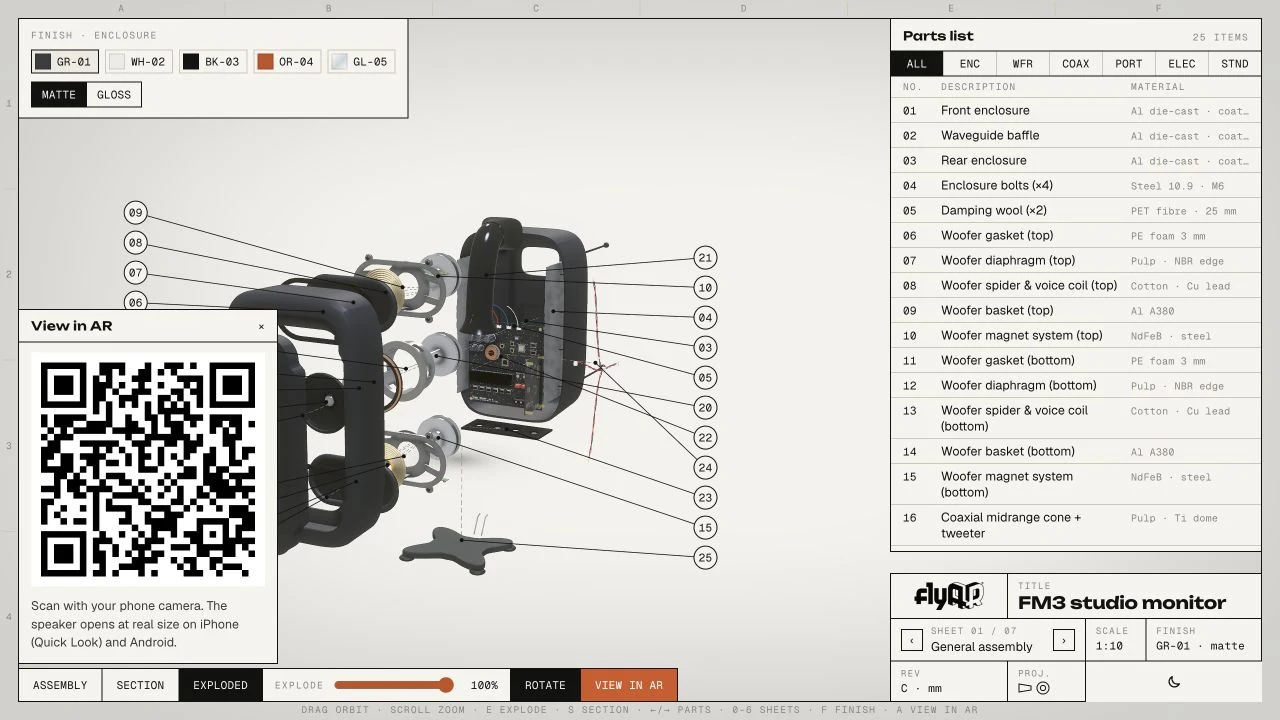
Open the demo and choose View in AR. On desktop, scan the QR code to open it on your phone.
Parts and finishes
Graphite, White, Black and flyAR orange. Glass is in the live demo.
FM3 monitor in graphite finish.
FM3 monitor in white finish.
FM3 monitor in black finish.
FM3 monitor in flyAR orange finish.
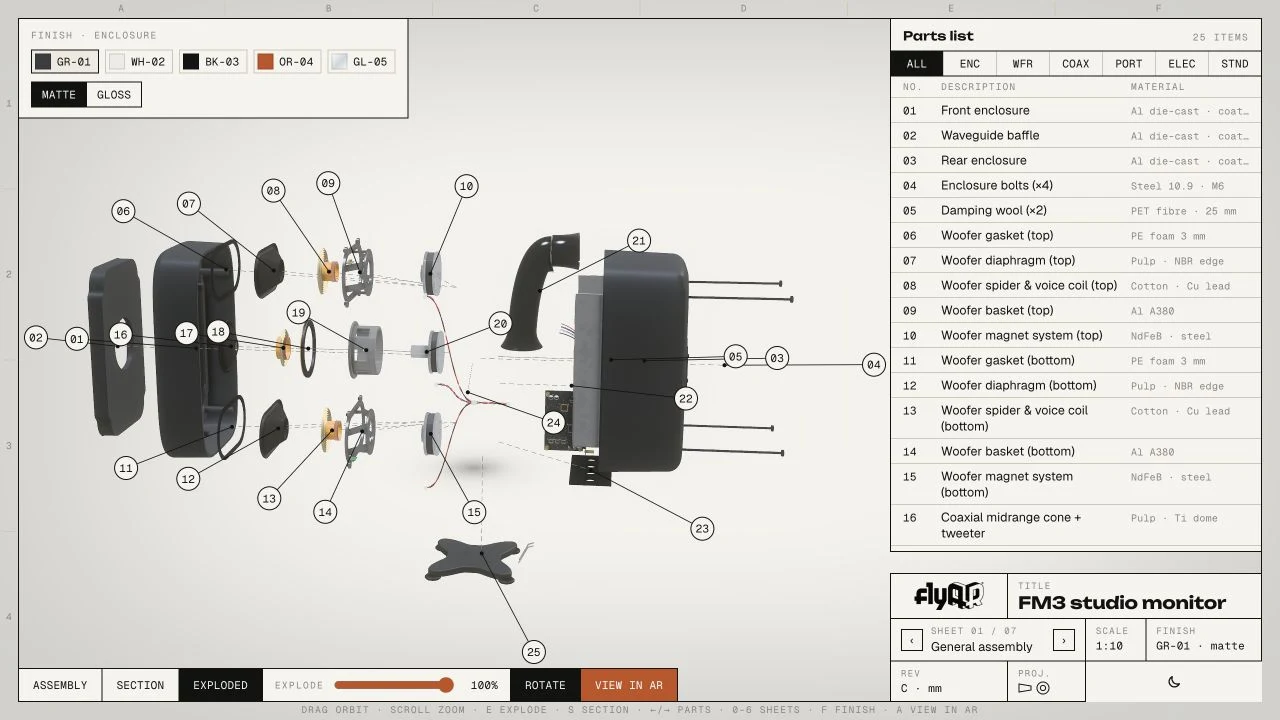
FM3 exploded assembly viewed from the side.
FM3 exploded assembly viewed from the front.
Electronics. Close-up of the FM3 amplifier board with heatsink, capacitors and connectors.
Rear of the FM3 monitor with the port and the connector panel.
Desktop interface with a numbered parts list, assembly sheets and an exploded-view slider.
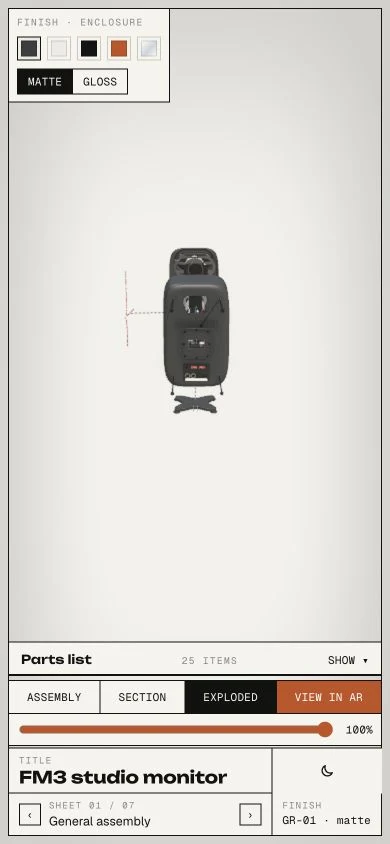
Phone layout with collapsible parts list and the same assembly, section and exploded-view controls.
The desktop View in AR panel provides a QR code to open the speaker on a phone.
01 Problem
Problem
Technical products sell on what is inside, but the inside rarely makes it into marketing. Cutaway photos are expensive and fixed, and spec sheets do not show how the parts fit together.
02 Approach
Approach
We modelled a fictional three-way monitor, the FM3, part by part: enclosure, waveguide, two woofers, a coaxial mid/tweeter, port, amplifier and stand. It is built procedurally in Blender and runs in PlayCanvas. The interface reads like an engineering drawing: numbered balloons, a parts list, sheets per assembly and a live drawing scale. You can explode, section and isolate any assembly, and switch between five finishes in matte or gloss.
03 Outcome
Outcome
25 selectable parts in 7 assemblies, each with a description and material
Assembly, section and exploded views, with an explode scrub
5 enclosure finishes, each matte or gloss
One button to place it in AR at real size: Quick Look on iPhone, WebXR on Android, QR on desktop
Runs on compatible phones, with no app and no plug-in
Inputs we worked from
Product reference photography
Public dimension drawings
Material references
Audiences
Product marketing
Sales teams
Trade-show stands
E-commerce
Deliverables
Web viewer
AR model (USDZ / GLB)
Stills for web and print
Service used
3D product configurators
Interactive browser-based 3D presentations for products, places, networks, and ideas that need more than a flat render.
AppsFlyer's 2025 benchmark across 28 billion installs puts Day-1 retention at around 25%. AR apps sit below that floor, because every reviewer is a single-use case, not a habit. WebAR removes the funnel. The link that opened the experience the first time still opens it the second.
Rework runs around 12% of a typical construction budget. Peer-reviewed BIM studies in 2025 report that putting an optimised 3D model in front of stakeholders before the first pour prevents at least a third of that, and as much as half on projects that share the model early. One Asian rail case caught 3,000 design clashes and shaved 12% off construction cost on its own.
Shopify's own data, drawn from millions of stores. The 65% sits next to a 94% conversion lift on stores that add any 3D content, and a 40% drop in returns when AR closes the imagination gap. The mechanism carries from product pages to construction, museums, and brand work.