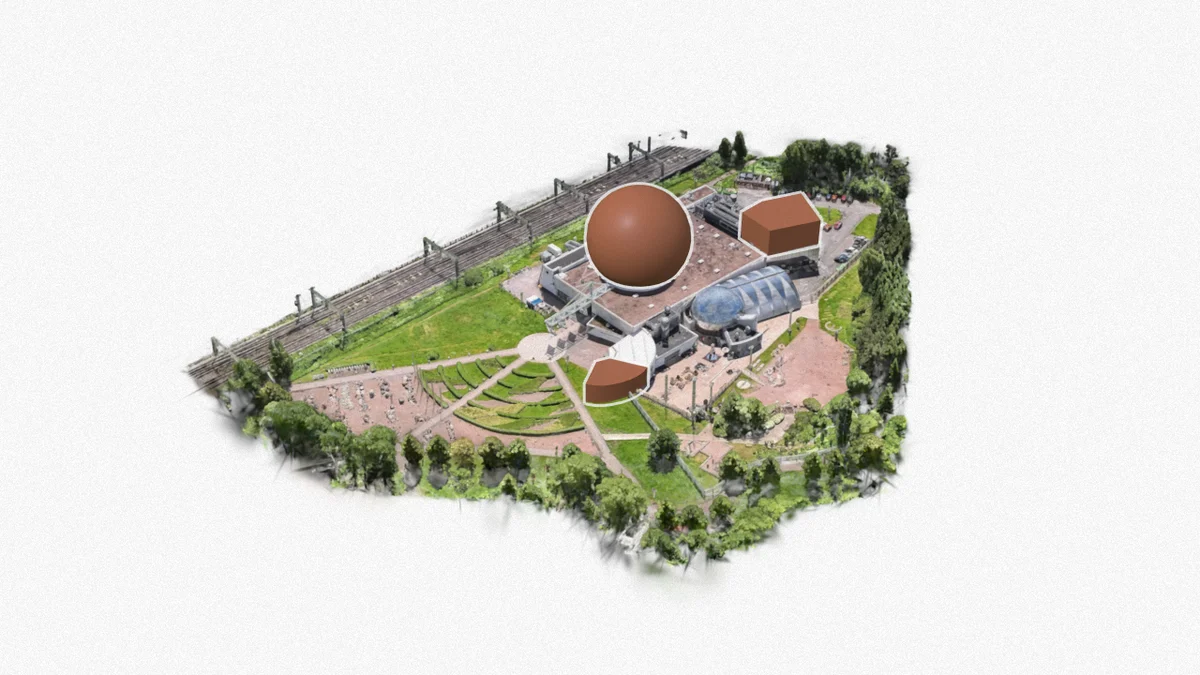
Aerial Gaussian splat material combined with future 3D mesh layers
Heureka future viz (demo)
A demo showing how aerial Gaussian splat material can be combined with traditional 3D mesh content to visualize future changes in an interactive browser experience.
Client
flyAR demo
Sector
Future visualization
Year
2026
Service
Aerial Gaussian Splatting
Delivery
Browser · QR
Heureka future viz (demo) · interactive 3D · only 13MB data loaded
01 Problem
Problem
A building change is hard to understand when the existing place and the imagined future are shown as separate drawings, renders, or screenshots. The viewer needs to see what changes, where it sits, and how it relates to the real site.
02 Approach
Approach
The site was scanned with a 360 drone, the footage was used to extract images for scene reconstruction, and the material was trained into a Gaussian splat. Future additions were then layered in as 3D mesh material with toggles that highlight or hide the imagined updates to the science centre building.
03 Outcome
Outcome
Existing place and future change can be inspected in the same spatial scene.
Toggle controls make the proposed updates easier to compare and explain.
The workflow shows how drone capture, 3DGS, and modeled 3D assets can support early future visualization.
Inputs we worked from
360 drone footage
Extracted reconstruction images
Future 3D mesh concept layers
Audiences
Property teams
Cultural destinations
Planners
Internal decision-makers
Deliverables
Aerial Gaussian splat processing
Interactive online viewer
Toggleable future visualization layers
Service used
Aerial Gaussian Splatting
Drone-enabled Gaussian splatting for places, construction sites and cultural heritage that need to be explored online.
AppsFlyer's 2025 benchmark across 28 billion installs puts Day-1 retention at around 25%. AR apps sit below that floor, because every reviewer is a single-use case, not a habit. WebAR removes the funnel. The link that opened the experience the first time still opens it the second.
Rework runs around 12% of a typical construction budget. Peer-reviewed BIM studies in 2025 report that putting an optimised 3D model in front of stakeholders before the first pour prevents at least a third of that, and as much as half on projects that share the model early. One Asian rail case caught 3,000 design clashes and shaved 12% off construction cost on its own.
Shopify's own data, drawn from millions of stores. The 65% sits next to a 94% conversion lift on stores that add any 3D content, and a 40% drop in returns when AR closes the imagination gap. The mechanism carries from product pages to construction, museums, and brand work.