Education
What could a 3D periodic table add to a chemistry lesson?
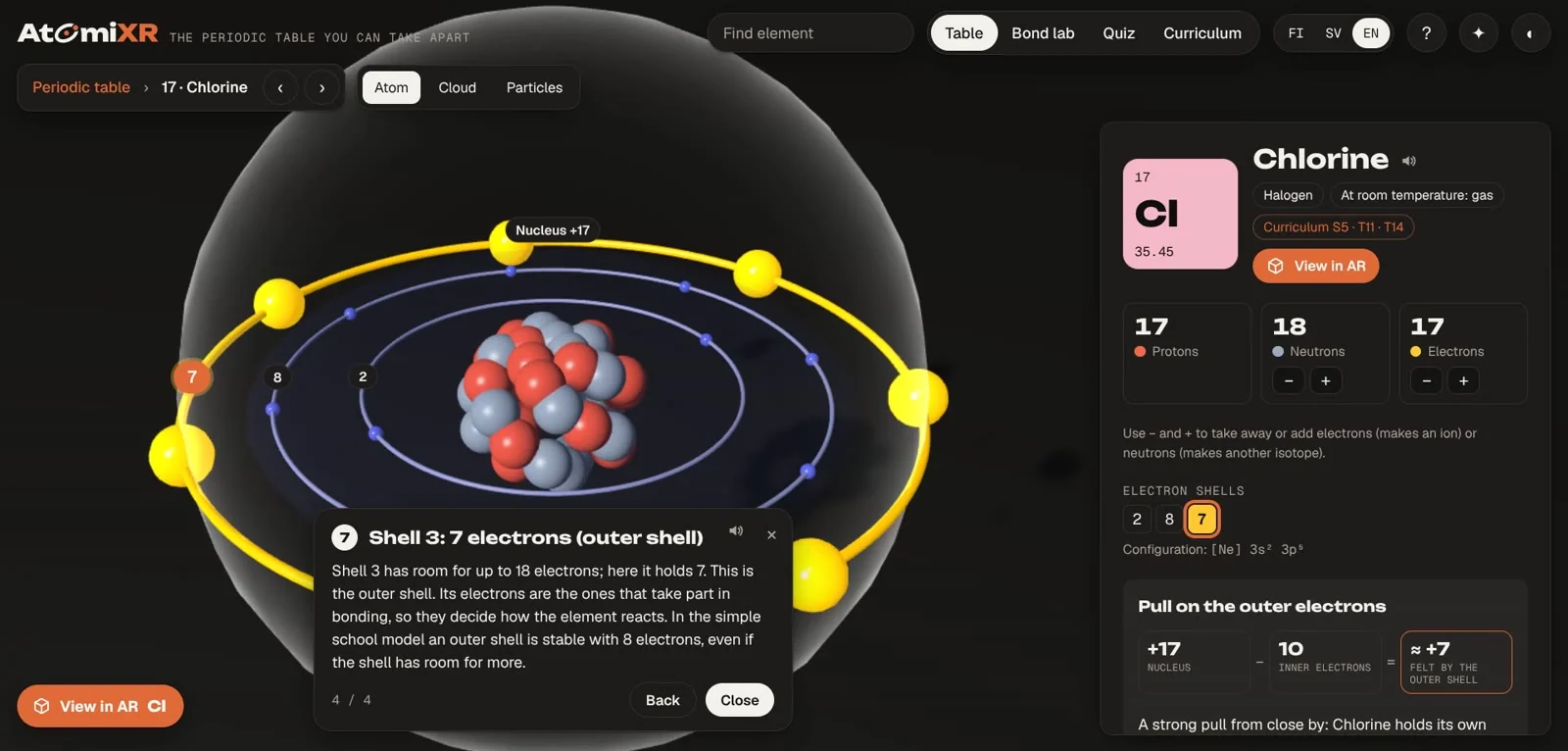
In short: AtomiXR is a free interactive 3D periodic table that runs in the browser in Finnish, Swedish and English. We made it as a studio experiment, using Finland’s lower-secondary chemistry curriculum as a reference. Here are five ways we’d like to try it in a lesson. It has not been tried with a class yet, and we are looking for teachers who want to be first.
The problem with the poster
The periodic table on the classroom wall is a result. It shows where the elements ended up, and pupils are asked to accept the order. The reasons for the order are invisible: the number of shells, the electrons in the outer shell, how hard the nucleus pulls on them.
Those invisible parts are what we wanted to make easier to see:
- Why do elements in the same group behave alike?
- Why does sodium give away an electron and chlorine take one?
- What is the difference between a molecule and a salt crystal?
- What actually changes when a substance melts?
These are questions about structure and movement. A flat picture answers them badly.
What an interactive model can do
It shows the reason, where the pupil is looking. In AtomiXR, tapping a shell number lights up that shell and opens a short card: how many electrons it holds, how many it has room for, and what that means for how the element reacts. The explanation is attached to the thing it explains.
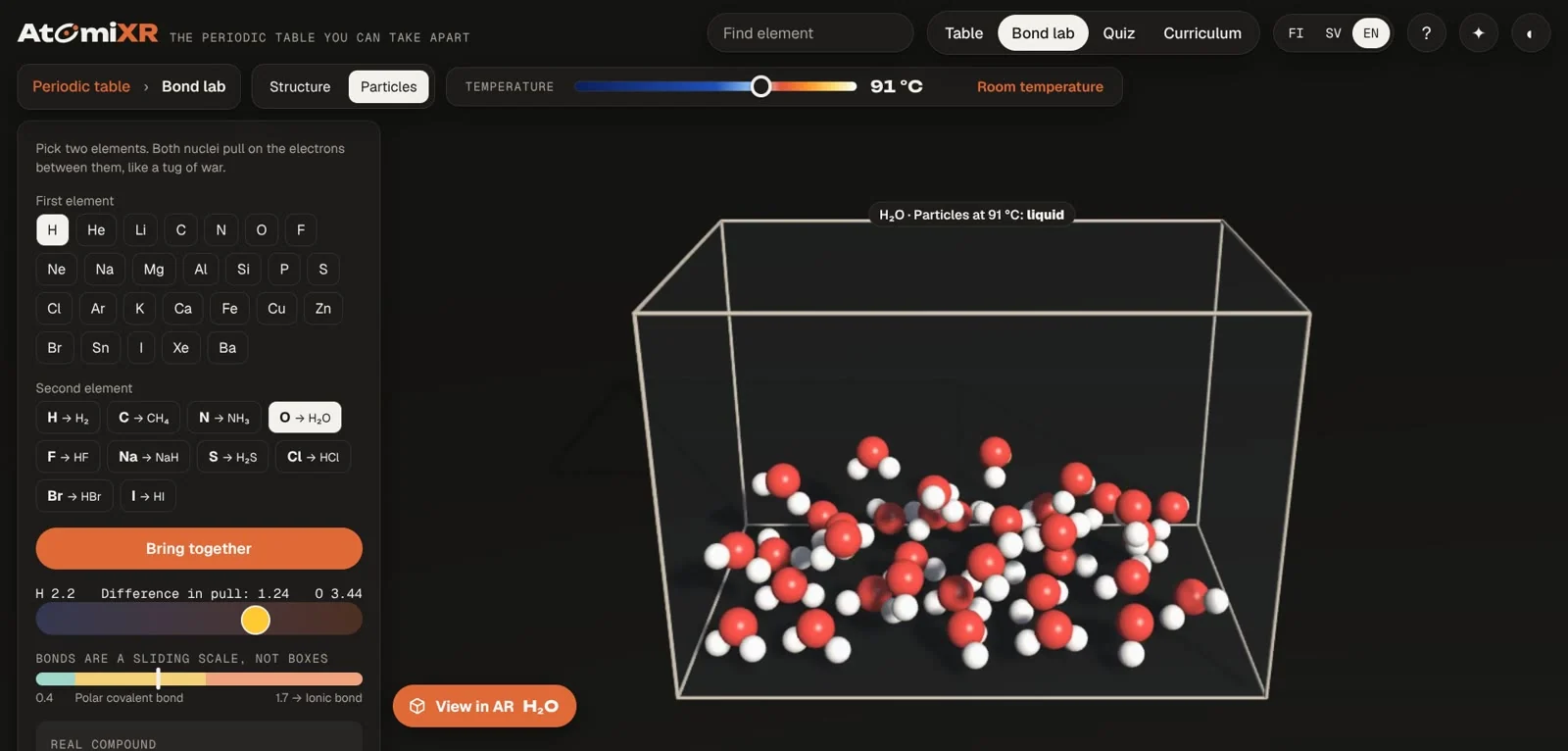
It lets pupils change something and see what happens. Take an electron away from sodium and the label becomes Na⁺. Drag the temperature slider and the particles of water stop holding their places, start to slide, then fly apart. The melting and boiling points are the real ones for each substance.
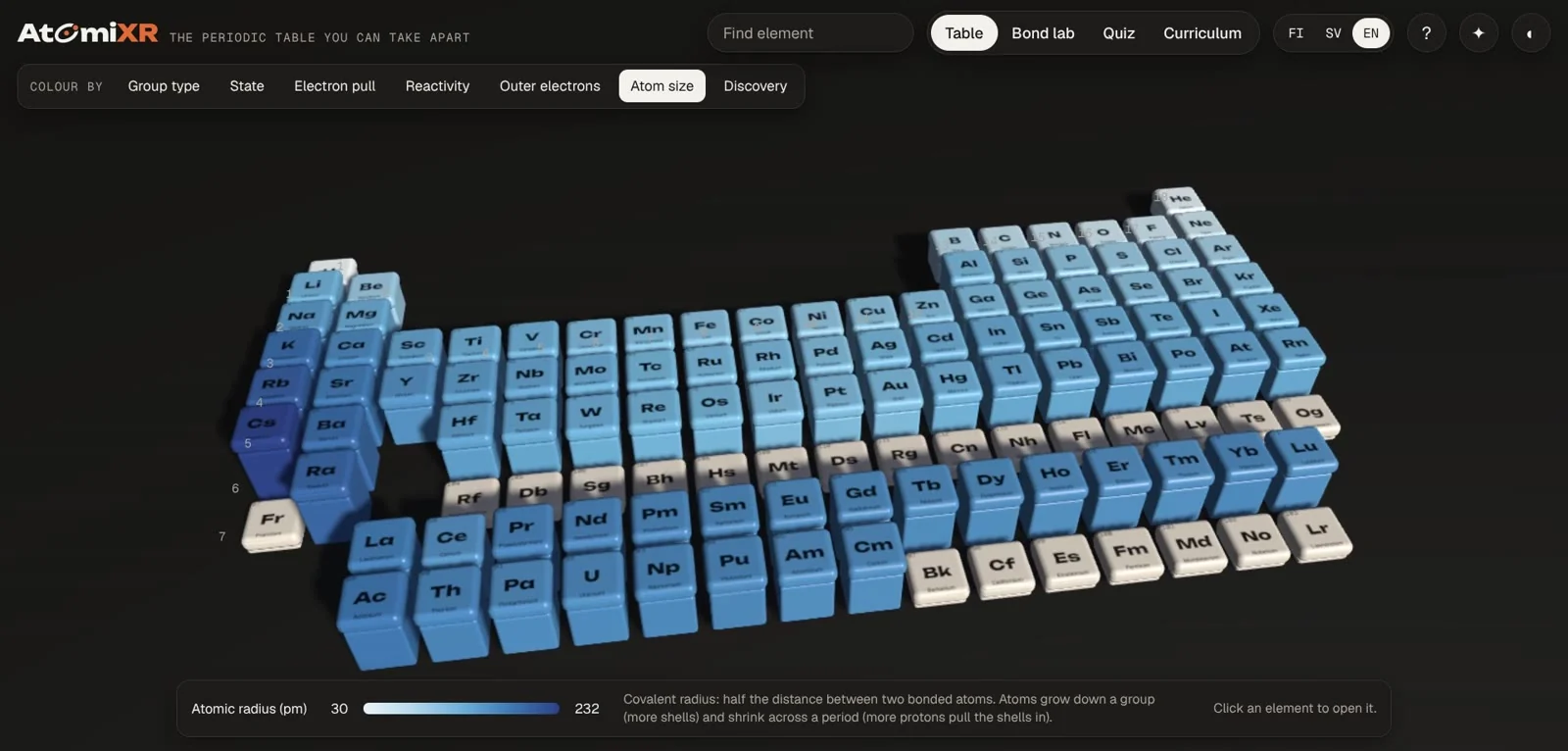
It makes trends visible. In atom size mode the tiles rise according to atomic radius. Pupils can see that atoms get bigger down a group and smaller across a period before anyone tells them the rule.
It connects the table to real substances. In the bond lab, pupils choose two elements and bring them together. The result is a real compound, with markers on the interesting spots. Water explains why it is bent. Table salt explains how an electron moved. Brass explains why metals conduct.
It is honest about models. The texts use the school models on purpose, and say where a model is a simplification. The shell picture and the cloud picture sit side by side, which is a good start for a conversation about what a model is.
Where we took cues from the curriculum
We used Finland’s lower-secondary chemistry curriculum (POPS 2014) when choosing topics. The Curriculum tab shows the connections we drew. Here are some examples:
| Topic in the lesson | In AtomiXR |
|---|---|
| Structure of the atom | Atom view, shells, nucleus card, ions and isotopes |
| The periodic table and its trends | Seven colour modes, atom size, discovery timeline |
| Chemical bonds | Bond lab with covalent, ionic and metallic examples |
| States of matter and changes of state | Particles view with a temperature slider |
| Models and their limits | Shell view and cloud view, notes in the cards |
Five things we’d like to try in a lesson
- Start of a topic, on the projector. Open the table in State mode and drag the temperature slider from very cold to very hot. Ask the class to predict which elements turn liquid first.
- Pair work on trends. Give each pair a group or a period. They switch between Outer electrons and Atom size and write down what changes and what stays the same.
- Build and explain. Each pupil builds one compound in the bond lab, reads its cards and explains to a neighbour why it holds together.
- Exit ticket. A five-question quiz on the day's topic. The hints teach the method without giving the answer.
- A game for the last ten minutes. In Atom detective, pupils see a picture of an atom and tap the right tile by counting shells and outer electrons. It practises the single most useful rule of the table.
Teachers can copy a link that opens a chosen element, view or compound, so the task starts where it should.
What we don't know yet
We have not tried AtomiXR with a class. The content has been checked against reference data several times, but no teacher has yet reviewed the Finnish and Swedish texts, and no pupil has used it in a lesson. That is the next step.
If you teach chemistry in grades 7 to 9 and would like to try AtomiXR, tell us what worked and what needs fixing.
Questions teachers ask
Is it free? AtomiXR is free to use for now. We might charge for some features later, but we haven’t decided yet.
Do pupils need accounts? No. There is no login and the app asks for no personal information. Language and best scores are saved only in the browser.
Which devices does it need? Any computer, tablet or phone with a recent browser. Nothing is installed.
Does it work in Swedish-language schools? Yes. The whole app, including quizzes and explanation cards, is in Finnish, Swedish and English.
Can it be used outside Finland? Yes. The chemistry is the same everywhere, and the English version works for any lower secondary course that covers atoms, the periodic table, bonds and states of matter.